|
Canadian Pacific Railway 4-6-4 Royal Hudson Scale: 10mm to the foot |
 |
|  |
 |
 |
| I have a love for finely detailed static models. This project was originally started quite a few years ago, 33 to be exact, with a view to producing models in 10mm to the foot scale, in very limited quantities, for sale to the serious collector. Unfortunately, as these models will be totally hand built, it will make them expensive. I don't anticipate I will find many buyers, but as I want one myself, I am going to build them anyway. The Canadian Pacific 4-6-4 Royal Hudson featured here happened to be right here in Western Canada, which gave me the opportunity to see and record, all the details I needed, in order to build a detailed model. Over 400 photographs
were taken by my Son Barry and I to date, of the B.C. Rail preserved locomotive 2860, here in
North Vancouver B.C. |
 |
 |
|
As we did not have to be concerned
about radius of track curves, and the many other considerations connected
with the mechanical aspect, full attention has been paid to detail and
to the best of my ability, getting it right. The models will have authentic bolt and rivet
detail, and the cab interior will show all gauges and controls.
The scale is large enough to show detail clearly, but not too big, as to
make it overpowering when displayed in the home or office. |
 |
 |
|
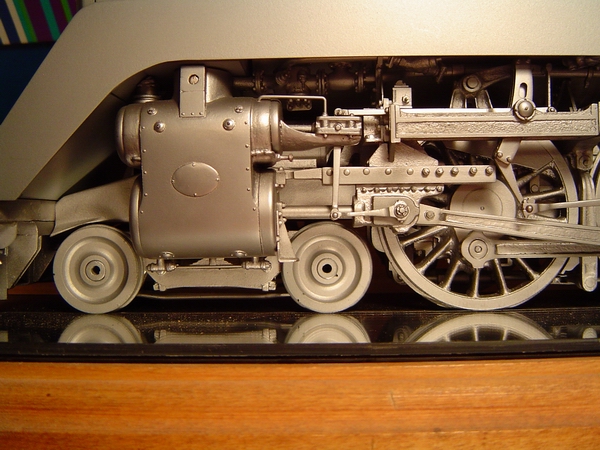
The pictures shown here are
of the prototype at various stages of construction. They
are meant to illustrate what the level of detail will be on the
finished model. The metallic finish is to show
detail on the photographs more clearly, but the models will
be painted in the correct livery when completed. |
 |
 |
 |
Hundreds
of hours have been spent on research, photographs, and drawings of the various component parts. Once the parts were built from plastic, Plexiglas and metal etc., silicone rubber molds were made, from which epoxy resin castings were produced. However, the prototype still has a long way to go. 
|
|
At this stage, production of my project was put on hold for many years, as our efforts were diverted into the world of motor racing presentation models, for the Indy Car race teams ___________________________________________ |
|
Model
steam trains are a life long passion with me personally, and as I
am now, semi-retired, I am looking to continue where we left off,
with the Royal Hudson project. I'm not sure how long it will take to complete, but I intend to do it as quickly as possible. My plan is to produce a model of the original Hudson 2860 oil burner, built in the 1940's, along with the 2850 Royal Blue Train, as well as the 2860 BC Rail restoration, based here in BC. |
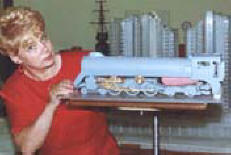
 Above picture illustrates the progress right now, of the Hudson. Everything you see below the footplate has been molded and cast. What you see above the footplate are the originals patterns, and molds still have to be made for the boiler, smoke box and cab. |
|
 Above
picture shows my Son, quite a few years ago, in the North Vancouver
BC Rail yard, down in the pit, under the Royal Hudson. Below,
my Son and I, enjoying a railroad
enthusiast's dream, to sit at the controls of the Royal Hudson. |
|
|
| By the end of 2018, the project was shelved again, due to house renovations etc. I had managed to get the tender box and chassis, and the two type of tender truck prototypes built, the Buckeye and the Commonwealth. |  |  | | Above, a couple of my drawings I did during the planning stage of the tender and trucks. ____________________________________________________ | | Late 2022 I started on my Hudson project again, with a plan to assembling 3 locomotives and tenders. These will be the first three models produced from these moulds. As originally planned, it will be one of each of the three versions. Very shortly I will post pictures of the progress of the three models _________________________________________________________________ | "Go and
see the British G.W.R. and L.M.S. Models in various
scales"
|


